Part A: 2-Mark Questions
1. Define structured programming
C is a structured programming language because it provides functions that enable us to break the code into small, manageable parts. This makes C programs easier to understand and modify. Functions also offer code reusability.
2. What is the purpose of a flowchart in problem-solving?
A flowchart is used in problem-solving to represent the logical sequence of steps in a program using standard symbols. This visual representation makes the program's logic easier to understand, analyze, and debug.
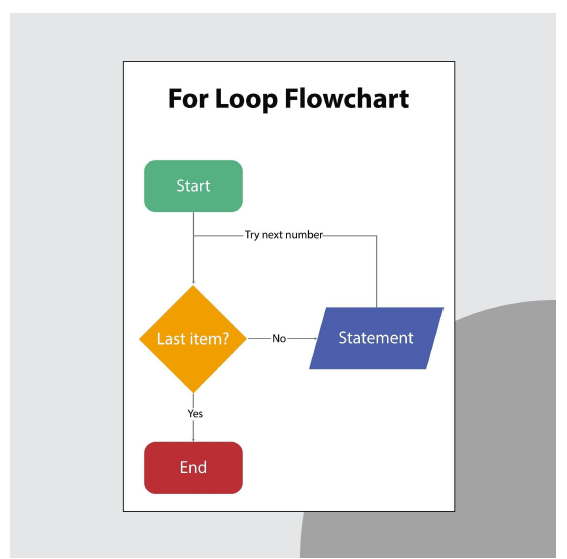
3. Write pseudo code to find the sum of n numbers
- Start
- Read n
- Initialize sum = 0, i = 1
- Repeat steps 5 and 6 while i ≤ n
- Read number
- sum = sum + number
- i = i + 1
- Print sum
- Stop
4. Differentiate break and continue statements in C.
| Break Statement | Continue Statement |
|---|---|
| Used to terminate the loop or switch statement immediately. | Used to skip the current iteration and continue with the next iteration of the loop. |
| Control transfers to the first statement after the loop/switch. | Control transfers back to the loop condition for re-evaluation. |
| Example: Exits the loop when a certain condition is met. | Example: Skips printing a value and goes to the next loop cycle. |
| Commonly used in switch and loops. | Only used in loops. |
5. Draw the structure of C program
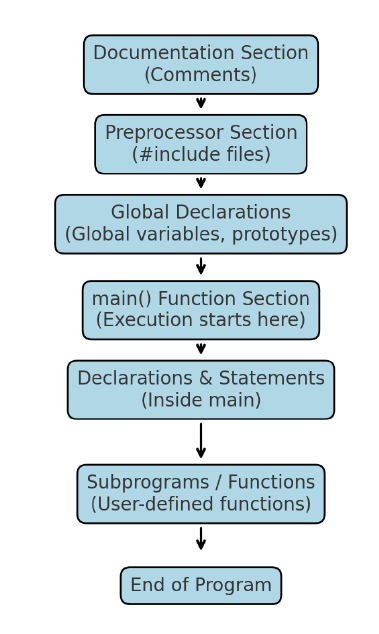
The main parts of a C program are:
- Documentation Section: Comments about the program, author, etc.
- Preprocessor Section: Header files like
#include <stdio.h>. - Global Declaration Section: Global variables and function prototypes.
- main() Function Section: The entry point of the program where execution starts.
- Subprograms / Functions: User-defined functions that perform specific tasks.
Code Example:
#include <stdio.h> // Preprocessor Directive

int main()         // Main Function
{
    // Declarations & Statements
    printf("Hello, World!\n"); // Example statement

    // Return Statement
    return 0;
}
6. What is the purpose of format specifier I/O statements?
The purpose of format specifiers is to tell the compiler what type of data is being read from the user (in scanf()) or printed to the screen (in printf()).
%d→ integer%f→ float%c→ character
7. Define programming Paradigm.
A programming paradigm is the fundamental style of computer programming. It determines how problems are solved and how solutions are represented in code.
Types:
- Imperative / Procedural Programming (like C)
- Object-Oriented Programming (OOP)
- Functional Programming
- Logical Programming
8. What are keywords? Give an example.
Keywords are reserved words in C that have a predefined meaning and purpose. They cannot be used as identifiers (like variable or function names) because they are part of the C language syntax.
Example: int, float, if, while, return